Vol. I  ·  The Commonplace Book Friday, 30 October 2026, Hong Kong
The Arjun Dispatch
Marginalia — Short-form Notes, Quotes & Reactions

6 Entries
On Meditations

Man, Am I Lucky

When I was really young, my family used to grow crops and farm in our backyard, and I used to slog through plucking out all the weeds by hand, watering the rows and rows of crop after crop and generally have a foul mood doing the grunt work.

Watching Thorfinn do it as a form of repentance as he felt he had sinned so much made me so mad I had ever been angry in that field as a kid. I realized I have been the most privileged person I have ever met in my whole life.

I never had any major family issues, my parents put me into hobbies that are still considered cool, I was blessed with an above-average intelligence, gifted with height, no crazy illness — and my parents are sufficiently well off to even send me off to a foreign country with no scholarship.

I have not seen any true hardship in life, and that's why I think I connected with Marcus Aurelius so strongly. Why stress and fret over petty issues?

On specialization, exposure, and Kekulé's snake

Why Did I Not Start 'X' Earlier

Every once in a while I get the thought, "Man. This thing is so amazing, I'm so good at it, if only I had done this earlier."

These thoughts completely left my brain when I opened my MyAnimeList last night.
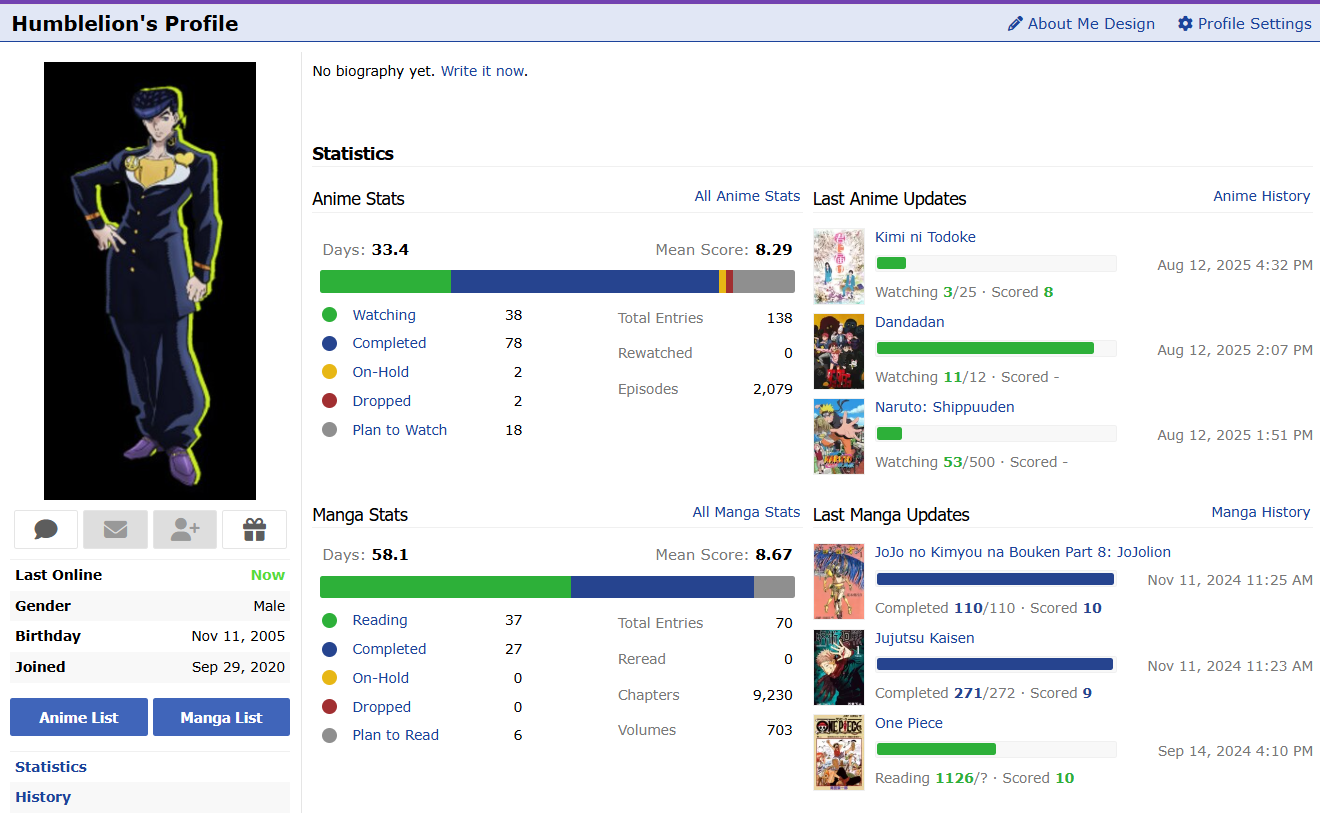
My MyAnimeList stats — 58 days on manga, 33 on anime

58 days spent on Manga, 33 on Anime. I was hit by this statistic like a truck (an isekai truck).

I have spent a hundred complete days of my life watching and reading anime and manga. I have been alive for 20 years, I sleep for 8 hours a night, which would mean I must have spent a whopping 2% of my life on Japanese cartoons. Wow.

Obviously setting aside the mild inaccuracy in numbers, this would mean that we often spend time on things that may seem inconsequential, and a waste of time looking back. There were times when I felt that I had smooth-brained myself by not spending all my free time on math prep, or I should have been on codeforces instead of manganelo back in the 9th grade, or I should have been designing PCBs instead of sketching landscapes back in the 10th grade (you get the gist of it).

Life is actually pretty simple, if you start specializing earlier, you can get exponentially more successful. Learning abacus in primary school helped in winning math olympiads in middle school — but life isn't really an optimization problem. It is equally important to remember my goal at that time in life wasn't to become an engineer at Google or a quant at Jane Street. I think back deeper, and I remember that kid who wanted to be an artist, then that kid who wanted to be a storyteller, the science student who thought he should make a manga about basketball. Reading books all throughout my life helped me connect with people from all walks of life.

We shouldn't disregard the broader exposure we get to life. Oftentimes, I see solutions to problems that I encounter in my work and studies from visions of my past, and sometimes in my dreams. There's a famous story that August Kekulé saw the structure of benzene in a daydream of a snake biting his own tail.

I wouldn't say I am a particularly gifted engineering student, but I know how to work hard enough, how to deal with other people, and how to deal with others' ambition while not losing my own. I would say this is a skill I developed only through watching TV, and then trying to apply the principles I could figure out onto my teammates and opponents in sports and debates in school. Knowing how other people felt about my actions was a skill that I developed from reading books. Both these skills are valuable in any domain, so I would say my time wasn't wasted.

And who knows — maybe the only reason I decided to pursue engineering is because I saw Dr. Stone, and the only reason I'm interested in Macroeconomics and History is because I read Billy Bat?

Six lines worth copying out

Paul Graham's Great Work

So you need to make yourself a big target for luck, and the way to do that is to be curious. Try lots of things, meet lots of people, read lots of books, ask lots of questions.

When in doubt, optimize for interestingness.

So you need to give different types of work a chance to show you what they're like. But a field should become increasingly interesting as you learn more about it. If it doesn't, it's probably not for you.

If you're making something for people, make sure it's something they actually want. The best way to do this is to make something you yourself want. Write the story you want to read; build the tool you want to use. Since your friends probably have similar interests, this will also get you your initial audience.

Take as much risk as you can afford. In an efficient market, risk is proportionate to reward, so don't look for certainty, but for a bet with high expected value. If you're not failing occasionally, you're probably being too conservative.

Some of the features of things you admire are flaws they succeeded despite. Indeed, the features that are easiest to imitate are the most likely to be the flaws. This is particularly true for behavior. Some talented people are jerks, and this sometimes makes it seem to the inexperienced that being a jerk is part of being talented. It isn't; being talented is merely how they get away with it.

Prof. Andre Geim at HKU, 8 June 2026

Random Walk to Graphene

Professor Andre Geim gave a public talk at The University of Hong Kong about his journey with graphene, the allotrope of carbon he discovered in the early 2000s.

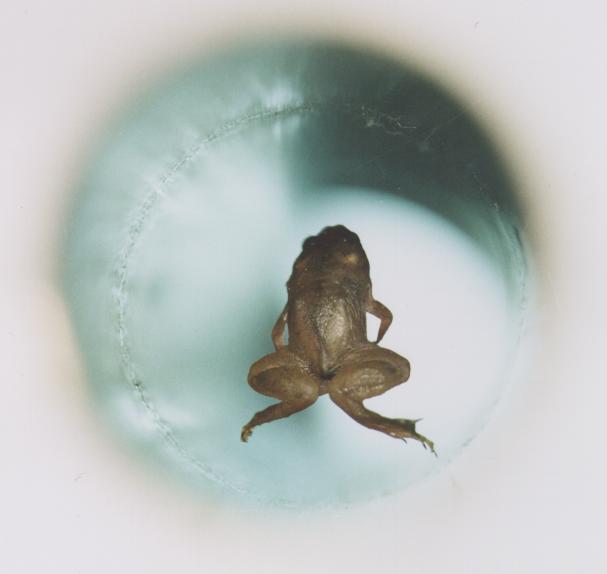
He started his tenure-ship with a series of experiments focused on curiosity. His first were on the "magnetic water" phenomenon — easily explained away with the diamagnetism of water, but nevertheless made for some engaging visuals and promoted science. His image of suspending a live frog in a sphere of water was striking enough to be put into textbooks around the world, while earning him the infamous Ig Nobel.

Live frog levitating in a 16-tesla magnetic field — the 1997 image that earned Geim the Ig Nobel

Loose notes from the second half of the talk, to expand later:

  • Klein tunnelling
  • Optics of graphene — fine-structure constant?
  • Graphene applications: dissolve electronics and filter through graphene to get gold; 2D crystals; mix-and-match stacking; monolayer assembly; VdW heterostructures; batteries
  • Neuromorphic circuits
What genius actually means

Crypto Stuff

Reading through stuff about crypto really makes you realize what genius actually means.

  • The concept of coming up with the whole architecture and a new currency took extreme intellect, well-thought-out planning, and sheer balls — yeah, we won't use dollars, but my currency instead.
  • And moving on from PoW to PoS also seems to take some insane amount of guts. I can see why so many people would be so interested in something like this.
Four rules from watching Bond

The Bond Way to Do It

Daniel Craig as James Bond

  1. Bond stays clear, sticks to the plan he sets for himself.
  2. Even when chasing a goon, he doesn't try to match the goon at what the goon's good at — instead, takes his own path.
  3. Not afraid to take risks, as long as he knows his final goal.
  4. Extremely good with technology; much of an engineer.