Money, War, Sex, Karma
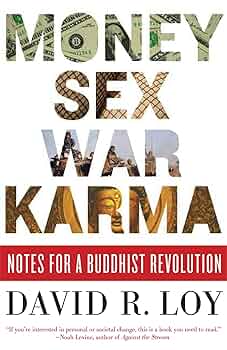
David Loy’s Money, War, Sex, Karma targets a fundamental human vulnerability: how our modern obsessions of accumulation, conflict, and desire are collective expressions of our deepest psychological anxieties. Reading through it, two core takeaways reshape how I view both intellectual frameworks and personal choices.
Takeaway 1: The Trap of Conceptual Rigidity
Loy anchors his arguments in the Buddhist concept of anatta (the lack of a permanent, fixed self) and Nagarjuna's concept of shunyata (emptiness or boundlessness). His core point is that language often works through us. The moment we experience reality, we immediately categorize it into terms, narrowing vast ideas down into rigid cognitive boxes.
We are heavily trained to do this. Distilling complex realities into structured narratives is a vital skill—whether you are explaining a concept to peers, pitching to stakeholders, or presenting to investors. We need frameworks to navigate anything beyond our immediate surroundings.
This tension mirrors a pattern highlighted in Daniel Yergin’s The Prize. History's greatest strategists and tycoons were obsessive readers of history. They didn't tackle global crises entirely from first principles; they relied on prior models and structures. Nothing we do is done entirely in a vacuum.
As Loy points out, the frameworks themselves are not the issue; but the danger lies in our rigid attachment to them. We mistake our mental maps for the actual terrain. The goal shouldn't be to abandon structure, but to maintain the fluid discipline to know when a framework has served its purpose and when it needs to be discarded.
Takeaway 2: The Illusion of Persistence and the Art of Letting Go
The most challenging aspect of Loy's text is its examination of dukkha (chronic dissatisfaction) and how it binds us to repetitive, cyclic behaviors. It forces a heavy realization: we often find ourselves trapped in exhausting, toxic loops—not because a situation has genuinely improved, but because we are fleeing from a temporary sense of internal loneliness or isolation.
When left alone with our thoughts, it is incredibly easy to seek validation from the very habits or people we swore we would step away from. We frequently mask this inability to let go as "ambition" or "persistence." We refuse to walk away because we subconsciously view ending something as a personal defeat—a loss.
This psychological trap perverts one of the most famous passages from the Bhagavad Gita, where Krishna states:
"You are entitled to your actions, but never to the fruits of your actions."
It is dangerous to weaponize this philosophy to justify dead-end investments or unrequited attachments, convincing ourselves that pouring energy into a broken situation is a noble act. That is a misunderstanding. True detachment means performing an action because it aligns with your highest values, and then possessing the strength to walk away regardless of the outcome.
Whether navigating a business venture, a habit, or a relationship, a builder must cultivate the ultimate discipline: knowing exactly when to drop a failing goal.